How Carrying Weight on One Side Affects Balance
Carrying weight on one side – such as holding groceries or wearing a backpack over one shoulder can change how you maintain your balance. A new study in Chiropractic & Manual Therapies examined how both backpack weight and carrying position affected balance in healthy young adults.
Dr. Dean Smith was one of the researchers. Here is what the study found and what those findings may mean for everyday carrying habits.
What the researchers studied
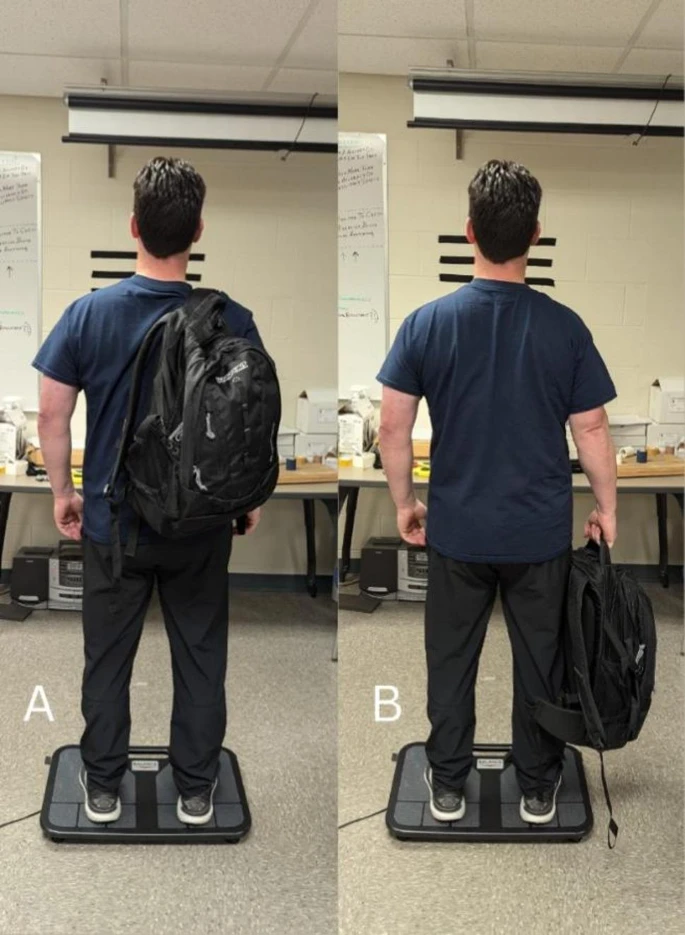
Researchers assessed 24 healthy young adults while they stood without a backpack, held a backpack in one hand, or carried it over one shoulder. The backpack (load) weighed either 15% or 20% of each participant’s body weight.
A force plate measured participants’ center of pressure (COP). This is the point on the ground where the pressure from your body is focused at any moment. Tracking how this point moves (often referred to as sway) helps researchers understand how balance is maintained.
What the study found
The main findings were:
- Carrying the backpack shifted the COP toward the loaded side, increased sway area, and increased the total distance the COP traveled compared with standing without a load.
- Heavier loads (20% vs 15% body weight) produced a greater sideways COP shift and more total COP movement.
- Total COP movement did not differ significantly between shoulder and hand carrying.
- Hand carrying produced a greater sideways COP shift than shoulder carrying, while shoulder carrying produced a larger sway area.
- Carrying the backpack did not significantly change the average forward–backward position of the COP.
In summary, the study found that load amount and carrying location each affected balance differently.
What this means for patients
The study measured balance during standing in healthy young adults – not pain or injury.
Both how much you carry and where you carry it matter when evaluating balance. Although the findings may help inform carrying recommendations, they do not prove that a particular carrying method causes or prevents musculoskeletal problems.
Everyday carrying habits could be a useful part of conversations with your chiropractor or other health provider about movement, balance, and the physical demands of work, school, and daily activities.
Study discussed: Rafi, A., Smith, D.L., Berg, W.P. et al. Impact of asymmetrical load magnitude and location on postural sway metrics in healthy young adults. Chiropractic & Manual Therapies 34, 57 (2026). https://link.springer.com/article/10.1186/s12998-026-00682-8